

Training
The 2027 Covenant Health Knoxville Marathon Training Runs presented by the Eddie’s Health Shoppe, Smoky Mountain Supplements, and Tennessee Pre
The program is intended for anyone looking to experience the fun, excitement, and camaraderie of training for the marathon. This program is being led by experienced runners and is open to everyone. The 2027 program is geared to not only marathoners, but half marathoners, relay, and 5K participants as well.
This is what we have to offer:
- Training runs for everyone! Runners of all levels are welcome to participate in the suggested weekly long runs. We will have several distance options ranging from beginner to advanced. The long runs will take place on most Saturdays at 8 am.
- Mileage for long runs for beginners and advanced
Looking for a customized training plan to get you to race day? Check out RunKNOX or Knoxville Endurance. RunKNOX is a group training program owned and operated by the Knoxville Track Club.

Group Run Cost:
• NOTHING! We are not requiring a fee for non-KTC members to participate in the training runs. However, we still encourage you to join the KTC and enjoy the benefits of being a member. You will receive discounts on registration fees at KTC races (including the Covenant Health Knoxville Marathon), purchases at participating retailers, and a subscription to the award winning KTC publication, Footnotes. For more information go to www.ktc.org.
How to sign up to receive the email reminders/updates:
- Contact us
- Follow us on social media (Facebook, Twitter, Instagram)
| Date | Week | Half Marathon | Marathon | Notes |
|---|---|---|---|---|
| December 5 | 1 | 2 miles | 6 miles | Runners Market - 4443 Kingston Pike |
| December 12 | 2 | 4 miles | 9.3 miles | CrossKnox 15K and 4 miler |
| December 19 | 3 | 4 miles | 8 miles | Eddie's Health Shoppe Downtown - hosted by Knoxville |
| December 26 | 4 | 5 miles | 8 miles | NO ORGANIZED GROUP RUN - HAPPY HOLIDAYS! |
| January 1, 2027 | 5 | 3.1 miles | 3.1 miles | New Year's Day 5K |
| January 2 | 6 | 5 miles | 10.5 miles | Eddie's Health Shoppe West - 8025 Kingston Pike |
| January 9 | 7 | 6 miles | 11 miles | New Balance Knoxville - 8027F Kingston Pike |
| January 16 | 8 | 8 miles | 12 miles | Runners Market 4443 Kingston Pike |
| January 23 | 9 | 5 miles | 10 miles | Oak Ridge 10 Miler and 5 Miler |
| January 30 | 10 | 5 miles | 10 miles | TBD |
| February 6 | 11 | 8 miles | 12 miles | Runners Market - 4443 Kingston Pike |
| February 13 | 12 | 10K | Half Marathon | Strawberry Plains Half Marathon and 10K |
| February 20 | 13 | 8 miles | 16 miles | TBD |
| February 27 | 14 | 9.5 miles | 19 miles | TBD |
| March 6 | 15 | 10 miles | 19 miles | Runners Market - 4443 Kingston Pike |
| March 13-14 | 16 | 10 miles | 20 miles | Pistol Ultra |
| March 20 | 17 | 10 miles | 12 miles | Fleet Feet Knoxville - 11619 Parkside Dr |
| March 27 | 18 | 10 miles | 12 miles | Runners Market - 4443 Kingston Pike |
| April 3 | 19 | 10 miles | 12 miles | Eddie's Health Shoppe Downtown - 455 Union Avenue |
| April 10-11 | 20 | 13.1 | 26.2 | RACE DAY!! |
NOTE: This is a recommended 9 week training plan that could get you ready for race day!
| Week | Distance |
|---|---|
| 1 | Alternate jogging and walking 1/4 mile intervals for a total of 1 mile |
| 2 | Jog 1/2 mi, walk 1/4 mi, jog 1/4 mi for a total of 1 mile |
| 3 | Jog 3/4 mi, walk 1/4 mi, jog 1/2 mi for a total of 1.5 miles |
| 4 | Jog 1 mi, walk 1/4 mi, jog 1/4 mi for a total of 1.5 miles |
| 5 | Jog 1 1/4 mis, walk 1/4 mi, jog 1/2 mi for a total of 2 miles |
| 6 | Jog 1 1/2 mi, walk 1/4 mi, jog 1/4 mi for a total of 2 miles |
| 7 | Jog 2 mis, walk 1/4 mi, jog 1/4 mi for a total of 2.5 miles |
| 8 | Jog 2.5 miles |
| 9 | Race Day! |
* The Saturday Morning Group Runs start at 8 am.
* Run locations are subject to change. We will make a weekly recommendation for mileage options. Please check this schedule or our Facebook page for weekly updates.
*This schedule is only a suggestion. Please listen to your body and be flexible with your runs. Do not fight injuries and rest when you need to throughout your training.
*Please consult a physician before beginning any exercise program. The KTC and the Covenant Health Knoxville Marathon Group Run Program are not responsible for injuries. We are simply offering a schedule of organized runs for individuals training for the marathon.
Sunscreen That Goes the Distance: Sun Protection for Long Runs and Race Morning in Knoxville
A Knoxville nurse and runner on the sunscreen that survives a three hour run, the spots runners miss, and what to carry to the aid stations.
By Sarah Hitchcox, RN, BSN
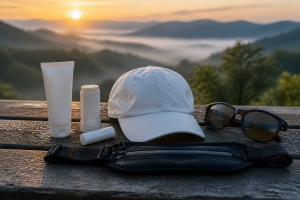
Mineral SPF before your run, a SPF stick for the aid stations, and a hat for the part line.
I ran my first marathon in Asheville this past March. I’m a registered nurse, I discuss skin concerns almost every day, and I still got the sunscreen part wrong on more than one training run. The application I put on for a walk to the car doesn’t hold up over twenty miles. Here’s how I handle it now, for long training runs and for an April race morning in Knoxville.
Why a long run is different
A long run is hours of sweat and friction. Your shirt rubs your shoulders, your hand wipes your forehead, your hat comes off and goes back on. Every one of those motions takes sunscreen with it.
The most important thing regarding SPF for a runner is whether or not it’s water resistant. The label says 40 minutes or 80 minutes. That’s how long the product kept its SPF in a lab test in water. Sweat isn’t the same as water, so that number is only a rough guide once you’re running. I treat 80 minutes as the outer limit and reapply sooner when I’m soaked.
The race in Knoxville is in April and starts early in the morning. That sounds like a low sun problem. It isn’t. If you’re running the full marathon you’ll still be on the course in late morning, when the UV index is climbing toward its peak. Clouds help less than you’d think. Plan for the sun you’ll finish in, not the sun you start in.
What I actually buy
I keep it simple. Broad spectrum, SPF 30 or higher, labeled water resistant for 80 minutes. That’s the whole spec. At my practice we recommend medical-grade mineral sunscreens (https://hitchcoxaesthetics.com/skincare). If you’d like help choosing one, come in for a free skin consultation, and we’ll look at your skin and put together a regimen that fits your training plan.
I use two types: a mineral SPF at home, because it spreads evenly and covers a lot of skin fast. I like a tinted one (https://hitchcoxaesthetics.com/skincare/sunbetter-tone-smart-spf-75), since it gives me a bit of coverage, almost like a confidence boost. A mineral stick (https://hitchcoxaesthetics.com/skincare/sunbetter-sheer-spf-56-stick) for the run itself, because it fits in a shorts pocket and doesn’t leave my hands slippery at a water stop.
Mineral sunscreens with zinc oxide sit on top of the skin and stay a little white, though tinted options like the one I use color-match to skin tone so they don’t look white. Chemical sunscreens absorb in and disappear, but when you sweat they tend to run into your eyes and sting. I don’t recommend chemical sunscreens for runners for that reason. Look for zinc oxide as the active ingredient, and pick a texture you can stand reapplying at mile 14, when you’re hot and tired. Just as you test shoes, gear, and nutrition during your training block, test out what SPF works for your skin on your training runs too.
One more thing about the forehead specifically: a good running hat with a brim is the easiest way to keep any sunscreen off your face altogether.
Before you leave the house
Put it on before you get dressed. Sunscreen needs about 15 minutes to bind to the skin, and you want it dry before the straps and the shirt go on. Face, ears, neck, chest, shoulders, arms, hands, legs. Then the hat, then the sunglasses, then out the door.
The spots runners miss
I see the same burns on the same places every summer, on patients and on other runners. Check these before you head out.
The advice runners hear in the office is the same as on the course: put it on before you leave, and carry the stick.
- The tops and backs of the ears. A cap doesn’t always cover them.
- The back of the neck, especially under a ponytail that swings as you run.
- The part line in your hair and any thinning spot on the scalp. A hat is the easiest fix.
- Your lips. Balm with SPF, reapplied whenever you drink.
- The shoulders under the straps of a tank or a hydration vest. Straps shift, and the skin under them ends up exposed and unprotected.
- The backs of the hands, which spend the whole run in the sun in front of you.
- The backs of the knees and calves. On the return leg of an out and back, the sun is behind you.
Reapplying at the water stops
Water stops are your natural checkpoints. On a long training run I pick a landmark every hour or so and actually stop to reapply. My full routine takes about ten seconds: wipe the sweat off with the back of your forearm first, since a stick on a wet face just slides around and doesn’t stick to anything, then ears, nose, cheekbones, back of the neck, tops of the shoulders. Keep moving.
Race day is different. You’re not stopping at every aid station to reapply, and that’s fine. I carry a stick and use it quickly at one stop somewhere past halfway, when the sun has had the most time to wear off what I put on that morning. If you’re worried about UVA/UVB exposure, a hat and sunglasses are an easy option to cut down on how much sunscreen you need to reapply.
East Tennessee humidity
Humidity changes two things. First, sweat doesn’t evaporate the way it does in dry air, so you stay wet the entire run, and wet skin doesn’t hold sunscreen well. Second, a cloudy sky can trick you into thinking the sun is weaker than it actually is. Heat and UV are two different things, and a muggy gray morning in Knoxville can burn you as badly as a clear one.
So in humid weather I reapply more often, and I never let how hot the sun feels decide whether I need it.
Race morning
Sunscreen goes on before the bib does. Yes, even at seven in the morning. Yes, even if it’s overcast. Depending on your pace and the race, you could be crossing the finish line anywhere from mid-morning to closer to noon, and the last few miles are the ones where your defenses are lowest and the sun is highest. Put a stick in your pocket and use it at a water stop somewhere past halfway.
What I see later in the office
At my Knoxville practice (https://hitchcoxaesthetics.com/) a large part of my work involves close, careful attention to skin, and years of sun add up in a way that’s easy to recognize. Brown spots along the cheekbones, uneven texture, fine lines that showed up earlier than they had to. Runners get one more: crow’s feet from squinting into the sun for hours. Good sunglasses help, and Botox (https://botoxknoxvilletn.com/) can be a great preventative measure, treating lines before sun-accelerated aging turns them into permanent, etched-in wrinkles. I believe in preventative treatments, and the cheapest one I know is sunscreen that’s actually on your skin when you need it.
For runners who already have some sun damage, chemical peels are one of the best options for treating it. There’s some downtime, a few days off from running and sweating, so I recommend scheduling a series of peels after your training block rather than in the middle of it.
Whatever else you do for your skin, sunscreen is the foundation. Put it on before you leave, carry the stick, and hit the water stops. That’s the whole plan, and it works for a Tuesday ten miler as well as it does for the marathon in April.
Sarah Hitchcox, RN, BSN, is a registered nurse and marathoner in Knoxville. Her practice, Sarah Hitchcox Aesthetics, also runs Knoxville Weight Loss Clinic (https://weightlossknoxvilletn.com/) and Knoxville Laser Clinic (https://knoxvillelaserclinic.com/
